Close
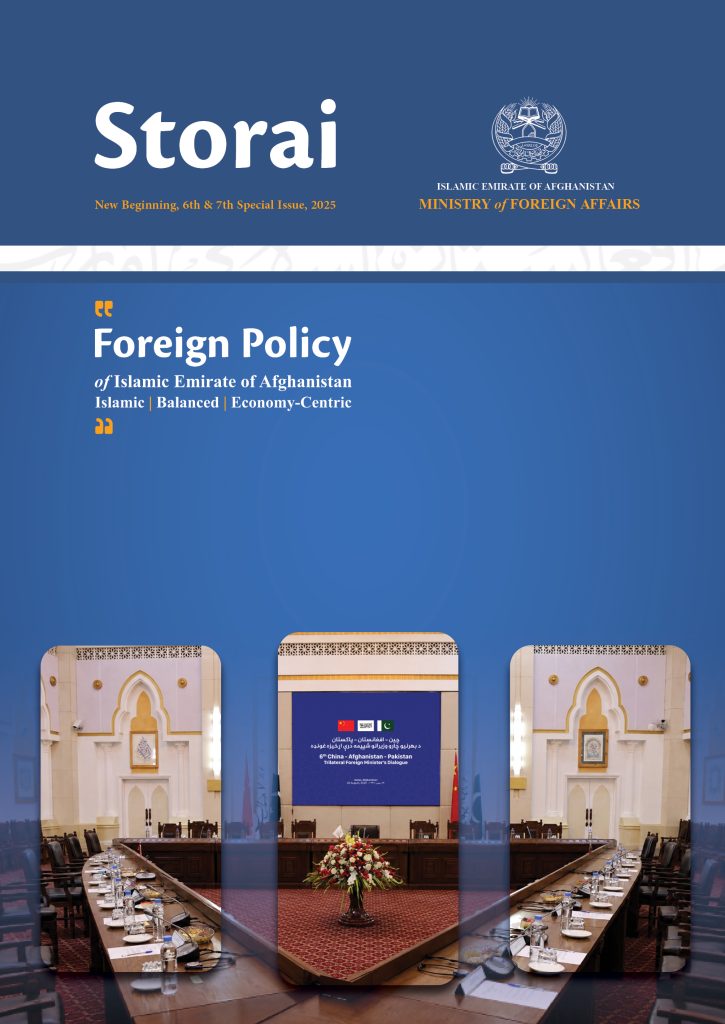
Following the end of the American occupation and the Victory, Afghanistan has pursued a foreign policy grounded in the principles of independence, balanced engagement, non-interference, mutual respect, and economic cooperation, in accordance with the teachings of Sharia. The fundamental pillars of the Islamic Emirate’s foreign policy, guided by the teachings of the Holy Religion of Islam, are safeguarding independence, balanced engagement, prioritization of economic cooperation, and the protection of supreme interests.
Following decades of war and political changes, Afghanistan has strengthened its national interests and political stability through an active foreign policy, created conditions conducive to economic development, and maintained active and balanced engagement with the international community. Furthermore, efforts are being made to avoid Afghanistan’s involvement in regional and international rivalries and to further expand its relations with various countries on the basis of mutual respect and common interests.
Engagement with neighboring countries, regional powers, and international partners extends beyond political relations. Particular importance is also attached to trade, investment, transit, energy, and joint economic projects. This economy-oriented approach can transform Afghanistan's geographical position into an economic opportunity, promote understanding, cooperation, and mutual interests instead of conflict and competition, strengthen the country's role in regional connectivity, and enable our beloved homeland to achieve lasting stability.
An economy-oriented approach is the defining features of the Islamic Emirate's foreign policy. Through economic diplomacy, efforts are being made to ensure that foreign relations extend beyond political engagement and create practical opportunities for the country's economic growth and development.
Having entered a phase of reconstruction and economic strengthening after several decades of war, Afghanistan needs extensive cooperation to achieve sustainable development. Therefore, expanding trade, attracting investment, developing industry, managing the impacts of climate change, operationalizing transit corridors, and participating in regional economic initiatives are considered among the key priorities of the country's foreign policy.
Furthermore, attracting foreign investment, supporting the private sector, improving the business environment, and managing natural resources are important factors in economic growth. The greater the confidence of international economic partners, the greater the opportunities will be for increasing production, employment, exports, and domestic revenues. Likewise, active participation in regional economic projects opens up new opportunities for Afghanistan to achieve sustainable growth and economic stability.
Relations with neighboring countries constitute an important dimension of Afghanistan's foreign policy, as they have a direct impact on border security, trade, transit, migration, and economic cooperation. Owing to their geographical proximity, economic relations, and regional cooperation, neighboring countries are regarded as important partners for Afghanistan. The Islamic Emirate strives to ensure that its relations with its neighbors are based on understanding and mutual interests, so that a conducive environment can be created for regional stability and economic development.
At the regional level, the Islamic Emirate is particularly focused on expanding relations with countries that offer opportunities for joint cooperation in trade, investment, energy, and transit. Afghanistan seeks to leverage its geographical position as an opportunity to strengthen regional cooperation and expand economic relations.
Afghanistan has now entered a phase of independence, stability, and reconstruction under an Islamic and independent system. Guided by Islamic and Afghan values, Islamic teachings, and Sharia rulings, Afghanistan has made notable progress in the areas of unity, strengthening security institutions, economic growth, and the reorganization of foreign relations. Today, Afghanistan is no longer a country defined from the perspective of conflict and regression.